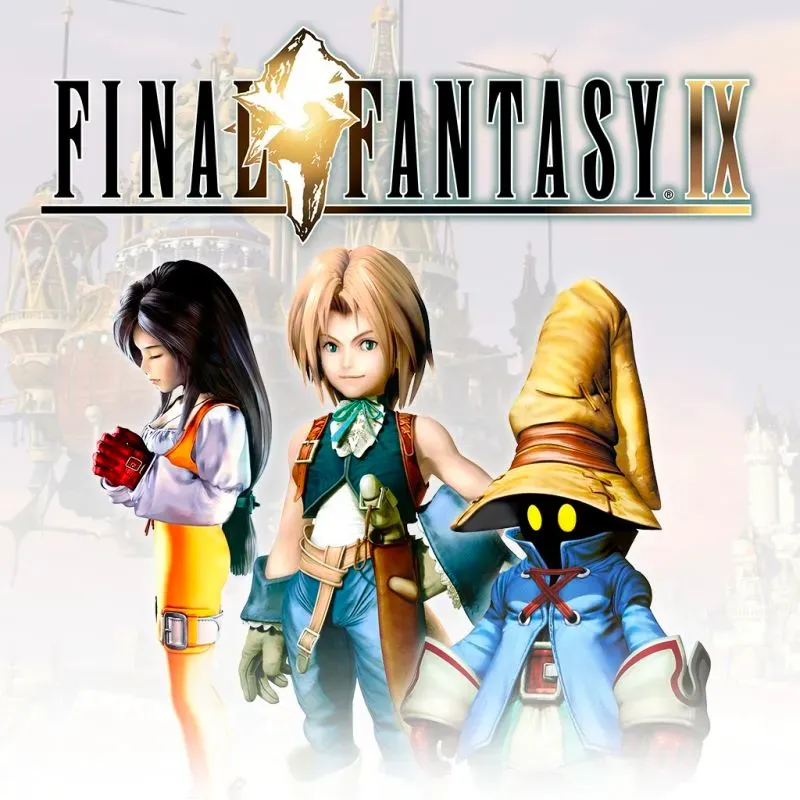

Platform: PlayStation 1
Developer: Squaresoft
Released: 2000
There's a version of the gaming discourse where Final Fantasy IX gets treated as the runner-up — the one that came out the same year as the PS2, the one that didn't sell as well as VII or VIII, the one people rediscovered years later and wondered why they slept on it. Don't let that framing fool you. FFIX is, by almost any measure, the best the series ever got on PS1. Possibly ever.
A deliberate step back that goes forward
Square made an interesting bet with this one. After Final Fantasy VII and VIII leaned into sci-fi aesthetics, moody protagonists, and increasingly abstract storytelling, IX went the other direction entirely. Back to swords and crystals and a world where magic is just part of life. Back to chibi-proportioned characters with big expressive faces. Back to the kind of game the series started as.
It could have felt like retreat. Instead it feels like clarity.
The story follows Zidane — a thief and member of a traveling theater troupe — who ends up tangled in a kidnapping plot involving Princess Garnet, her increasingly unstable mother Queen Brahne, and a conflict that slowly reveals something much larger underneath. What starts as a relatively lighthearted adventure gets genuinely heavy by the back half, and the game earns those emotional beats through the cast rather than through cutscene spectacle.
The best ensemble in the series
This is the thing that makes FFIX hard to shake: almost every character in your party is actually interesting. Not just "has a defined function" interesting — actually interesting as a person.
Vivi is the standout. A young Black Mage grappling with questions about whether he's truly alive, whether his existence has meaning, and what happens when things end — it's surprisingly affecting material for a game with cartoon proportions. His friendship with Steiner (a knight defined entirely by rigid duty who slowly, reluctantly becomes a decent person) is one of the best character pairings in any JRPG.
Even the weirder party members — Quina, the genderless blue mage who is only interested in food; Amarant, the lone-wolf bounty hunter — get moments that complicate the obvious archetypes. Not everyone reaches Vivi's heights, but nobody is just a job class in a costume.
Zidane himself is a nice departure from the brooding leads that VII and VIII gave us. He's confident, frequently funny, and genuinely cares about the people around him. The game does eventually push him toward a crisis of identity, and how that's handled is one of the better late-game sequences in the series.
The systems are clean
The battle system here is a refinement of the Active Time Battle that the series had been running with for years — four characters, turn-based with a moving timer, nothing revolutionary. But it's well-tuned, and the equipment-based skill system adds a layer of progression that keeps item management interesting. Characters learn abilities by equipping gear and earning AP — once learned, the ability is yours even if you swap the gear out. It means you actually think about what you equip, which is a better loop than it sounds.
There's also a genuine variety in party composition since each character has a distinct playstyle. You can't just run the same three people through the whole game — the encounter and story design pushes you to use everyone, which is a small thing that actually matters a lot.
Nobuo Uematsu's score is worth singling out. This was his last solo composition credit on a numbered Final Fantasy, and it shows — the music is exceptional throughout, ranging from playful town themes to genuinely haunting dungeon tracks. "You're Not Alone" hits harder than it has any right to.
The caveats — and there are some
The encounter rate is brutal by modern standards. Random battles happen constantly, and while the battles themselves are fine, the frequency gets old during long dungeons. There's no way around it on original hardware.
The final boss is the most commonly cited issue, and it's warranted. After a story that builds to a very specific, emotionally coherent conclusion, the game introduces a different antagonist in the last stretch who feels disconnected from everything that came before. The final hours still work in terms of spectacle, but the narrative logic frays in a way that's genuinely puzzling.
Load times on the original PS1 discs are also real. The game loads before and after every battle, every ability, every summon. If you've never played a PS1-era RPG, be ready for that.
Worth it?
Yes, clearly. The flaws are real but they're the kind you push through, not the kind that undermine the experience. FFIX is a game that knows exactly what it wants to be and executes it with unusual confidence — a love letter to classic fantasy that happens to have one of the best ensemble casts in the genre, a genuinely moving story about identity and mortality, and music that holds up completely.
It got overshadowed at launch by the PS2 hype. That's the PS2's problem.